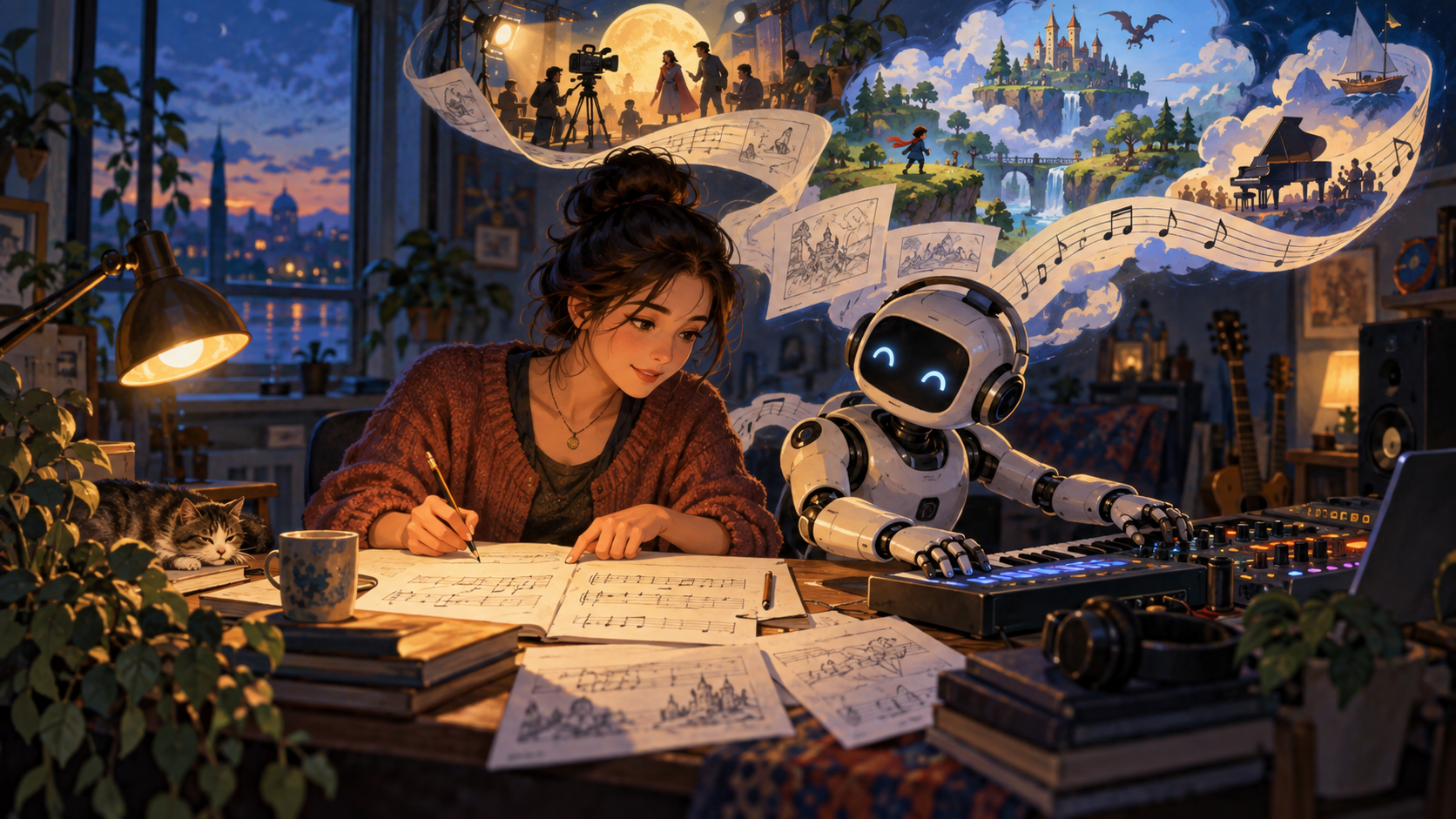
When I was young, I wanted to be either a screenwriter, a musician, or a videogame designer. So, obviously I decided to study computer science and have a Letterboxd and sing karaoke on the side. I haven’t given up my artistic aspirations, though. I still dream of one day releasing an album, a movie, or an indie video game. Even now, working as an AI researcher, I think most of my joy comes from the act of doing something that’s never been done before. Unfortunately, my forays into music production have shown me that producing a song that actually sounds professional takes a lot of time and expertise, neither of which I have enough of right now.
The equipment is less of a barrier than it used to be. Billie Eilish and Finneas famously recorded her debut album in his bedroom. But even they hired an experienced mix engineer. And Finneas had already spent years learning his craft, having started recording and producing music at 13.
And so I’ve shelved my artistic dreams for now, telling myself I’ll get to them later. I think this is the third year that my New Year’s resolution has been to produce a professional sounding song. Every year, my list of ideas for songs, movies, and videogames gets longer.
I still have a sense of what I want these things to look and sound like. If only I had a producer who could sit down with me and help bring them to life. I suspect a lot of people feel some version of this. Who hasn’t imagined another story in their favorite fictional universe, or a game they wish existed? Having the idea is easy. Finding the time, money, and expertise to make it is much harder.
Which brings me to AI art.
Until recently, I was against it. But then I started looking into what people were making, and I was pretty impressed.
There’s Suno for music (see examples on the website). In film, some recent ones:
- Grandma vs Wasp turns a grandmother’s breakfast into an escalating battle with a wasp.
- Scratch follows two crash-test dummies trying to escape the people who made them.
- Jailbird tells the story of a chicken sent to a human prison, from the chicken’s perspective.
- Jacob Adler’s Total Pixel Space explores the idea of every possible digital image, including every life you could have lived.
For longer fiction, Brad Feld has been publishing Zero Knowledge chapter by chapter in 2026, using an AI collaborator to draft from his outline before substantially rewriting the results.
I’m not saying we’re all the way there yet. There’s still something unsettling about a lot of these songs and movies. But I remember what the outputs looked like a few years ago. Extrapolating from that progress, it seems plausible to me that many of the remaining technical limitations will become less important very soon.
Would that be good? Should we want art to remain a firmly human endeavor, even if we could somehow get everyone to agree to that?
I think it helps to distinguish two parts of creating art: creative vision, knowing what you want to create, and creative execution, having the skills and tools to create it.
These don’t always go together. In Time has a great premise: people buy and sell years of their lives, so the rich can live forever while the poor struggle to survive the day. But its flat characters and generic chase scenes never live up to that idea. John Wick goes the other way. A retired hitman gets revenge after someone kills his dog. There’s little novelty in the revenge plot, but the choreography, camera work, and Keanu Reeves’s performance make it compelling.
The tools of creative execution have already changed enormously. Writers have gone from handwriting to typewriters to word processors. Music production has expanded from recording instruments to synthesizers, samples, and virtual instruments. Software can even supply bass, piano, and drum performances that respond to your direction.
These tools let one person attempt projects that would otherwise require several people with different skills. They also change which skills matter. I don’t need to be able to play the drums to arrange a drum part on a computer, but I still need to decide what that part should sound like.
Acting is another interesting example. Because it uses the body, it’s easy to think of it mainly as a physical skill, like being able to cry on cue or deliver a line convincingly. But so much of acting is in the choices. Is the character trying to hurt the other person or get them to stay? Is the laugh sincere, nervous, or an attempt to hide something? What are they trying not to say?
If you want to see how much those choices matter, Tristan Spohn has a very addictive series comparing different actors performing the same scene. The words stay the same, but the scene changes. Acting on a stage, in a silent film, or in a close-up gives you different ways to express those choices.
This is also why I wouldn’t divide artists into the people with the vision and the people who merely execute it. A performer or producer contributes a vision of their own. What excites me about AI is the possibility of making more of those choices accessible to people who can’t currently realize them. I could try a different arrangement without learning another instrument. Someone with an idea for an animated film could make it without being able to draw very well.
There’s an obvious difficulty here: some of the execution being made cheaper is someone’s job.
We have historical examples of this. The American Federation of Musicians estimated that by 1930, the move to sound films had eliminated 22,000 jobs for musicians accompanying silent movies. The fact that a new technology lets people make something more cheaply doesn’t mean the transition is painless for the people whose skills it replaces.
Two things give me hope here. I suspect many of the people whose jobs are threatened by AI have creative ambitions of their own: animators who want to direct films, or session musicians who want to make their own albums. The same tools that put their jobs at risk could also make those projects possible.
I’m also confident there will still be demand for live performances. Being in a room with a person doing something difficult has an appeal of its own. As digital content becomes more abundant, my guess is that these experiences will become even more valuable. So maybe actors will have to go back to the stage, or musicians will have to go back to live performance.
There’s also a difference between having access to a powerful tool and making something worth sharing with it. The possibility I’m excited about is a process of collaboration. You describe what you want, see or hear a version of it, and work out what needs to change. The chorus arrives too early. The vocal is too polished. The character looks angry when they should look like they’re trying not to cry. You try again. Sometimes the result helps you realize that your original idea was wrong.
That can involve a lot of judgment. You need to notice the difference between something that merely looks finished and something that expresses what you wanted. A generated result can also contain choices you never asked for, so part of the work is deciding which of those choices belong in the piece. AI lowers the barrier to entry, but it doesn’t remove the need for effort. In fact, low effort is part of the definition of AI slop. You still have to pay attention, reject things that don’t work, and keep refining the result. Skipping that work is how you end up with slop.
For now, I’m firmly in support of AI as a tool for creative execution. I want more people to be able to make the things they imagine. That includes people who have spent years developing a craft, and people like me whose unfinished ideas keep accumulating in a notes app.
Whether AI will also replace creative vision is a more complicated question, and one I’ll leave for a future post.
For now, I've got a song to produce.